
Perhaps we’ve been looking for the answer in the wrong place.
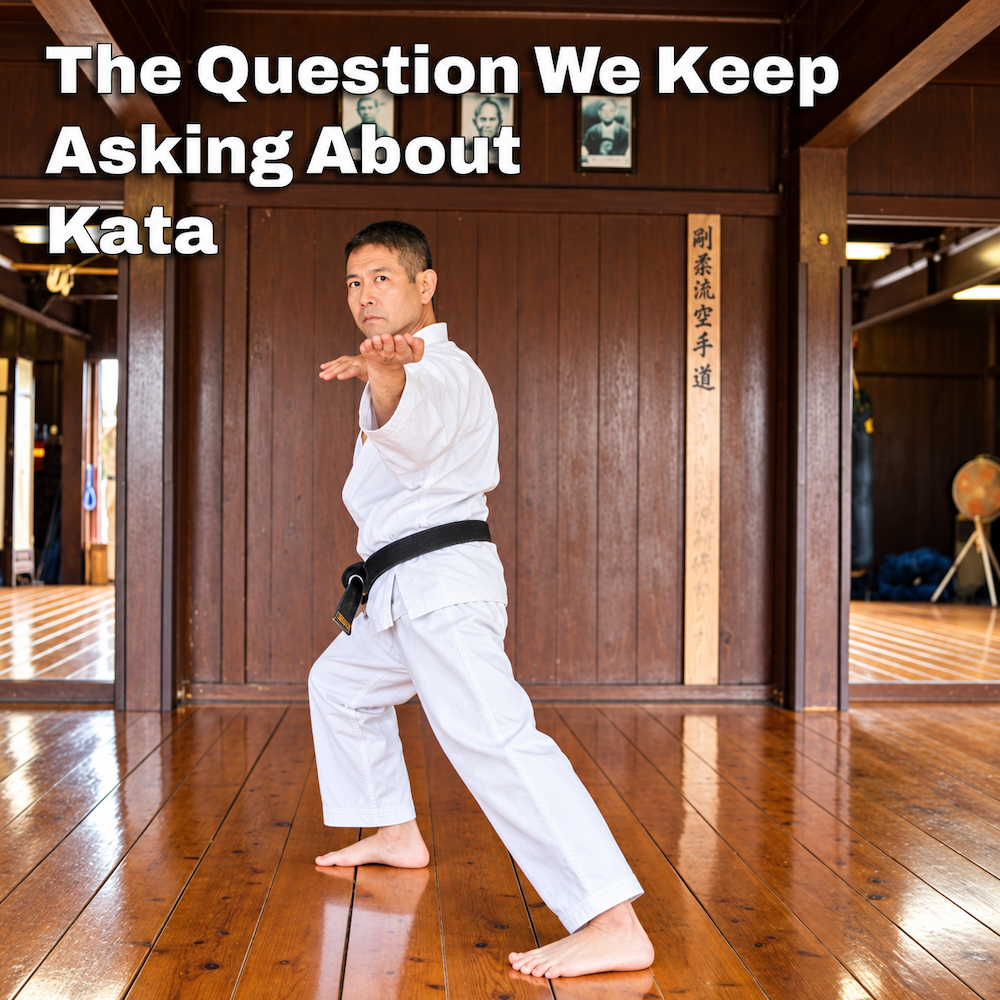
A few days ago, someone left a comment on one of my articles asking, “Be honest, how effective is kata in a fight?”
It’s a question I’ve heard many times over the years, and one that continues to surprise me, particularly when it comes from people who have spent time training in karate.
But perhaps the question itself is part of the problem.
Let me ask something else.
How effective is shadow boxing in a fight?
A boxer doesn’t expect to defeat an opponent by performing a shadow boxing routine. Yet nobody seriously suggests that shadow boxing is therefore useless.
Boxers use it to rehearse movement, combinations, positioning, balance and other aspects of their boxing. They don’t expect the imaginary opponent to suddenly become real.
But they also work with heavy bags, focus mitts and training partners. They spar against resistance, learn to deal with pressure and discover what happens when an opponent doesn’t cooperate.
Shadow boxing is one part of a much larger training process.
So why do we expect kata to be judged differently?
Now, I’m not suggesting that kata and shadow boxing are exactly the same thing. They aren’t.
Kata also serves as a means of preserving movements and principles that can be explored through two-person drills. Its movements can provide a framework for dealing with common physical problems, but that framework has to be understood and developed through practice with another person.
The solo performance is only one part of the process.
The effectiveness comes from how the material is understood, practiced and tested, not simply from performing the kata.
Someone could practice kata beautifully for thirty years and still be unable to apply its movements against an unwilling opponent.
But someone could also spend thirty years shadow boxing without developing much fighting ability if that were the extent of their training.
Neither observation makes the solo practice worthless. It simply demonstrates the limitations of relying on it alone.
And I think this is where much of the misunderstanding surrounding kata begins.
For years, many karate students have been taught kata primarily as a sequence of movements to memorize, refine and perform for examinations. They’re expected to demonstrate the correct positions, timing and appearance, often without being shown how those movements relate to dealing with another person.
Then, when someone asks what the kata is actually for, they’re given an explanation involving an opponent standing at a convenient distance, attacking in a predetermined way and waiting for the response.
It’s hardly surprising that people question its usefulness.
And I don’t think we can blame them entirely.
Karate instruction itself bears considerable responsibility for the misunderstanding.
If we teach kata as little more than a performance, we shouldn’t be surprised when people judge it as one.
But there’s another side to this.
Just because we can demonstrate a plausible application for a movement doesn’t mean we’ve established that it works.
An explanation might look perfectly convincing when our partner knows what’s coming and cooperates with everything we do. That tells us very little about whether we can make it work when someone resists, changes their response or behaves unpredictably.
That’s why the partner work matters.
The movements in kata may preserve methods that were originally practiced with a partner. Our task is to understand the problems those methods addressed, explore them through two-person drills and test our understanding with variation, resistance and pressure.
Sometimes an interpretation that looked convincing turns out to be impractical. That’s useful information too. We should be prepared to change our understanding rather than defend an explanation simply because it has been associated with a particular kata.
The purpose isn’t to prove that every movement must work exactly as we’ve interpreted it. It’s to develop skills that can be used against another person.
And there is an important distinction between finding something useful within kata and claiming that kata itself teaches us how to fight.
It doesn’t, at least not in isolation.
Neither does shadow boxing.
I also think we need to be careful about the word “fight”. Are we talking about consensual fighting, competitive sparring or an unexpected act of violence? The problems involved aren’t necessarily the same, and neither are the training methods we might use to prepare for them.
That distinction matters when we’re discussing effectiveness.
What interests me about the original question is the phrase “Be honest”.
It almost suggests that anyone defending kata must be reluctant to admit something.
But there’s nothing dishonest about acknowledging its limitations. I’ve never believed that performing kata, however well, automatically gives someone the ability to protect themselves.
The question is what we do with the material it contains.
If we never explore it with a partner, never introduce resistance and never discover what happens when things don’t go according to plan, then I think we’re missing a substantial part of its potential value.
On the other hand, dismissing kata simply because the solo performance doesn’t resemble a fight is rather like dismissing shadow boxing because the boxer isn’t actually hitting anyone.
Both arguments overlook the purpose of the practice.
Perhaps instead of asking how effective kata is in a fight, we should be asking something more useful.
What are we learning from it, how are we training that material, and can we make any of it work against someone who isn’t cooperating?
The answers to those questions tell us considerably more than the performance of a kata ever will.
Help Keep Applied Methods Free
Applied Methods is independently written and freely available. If you enjoy the articles and would like to support the continued writing and upkeep of the site, contributions are always appreciated, but never expected.
I see kata as the code: the way karate was preserved and the way it is transmitted to next generations; I also agree with the idea that kata is a way to perform solo training; but if kata is the code, kumite and personal defense should be the apps; I mean, we learn the code but we need to develop the app: every practicitioner must study kata, understand them and then interpret and adapt them to fight.
Arigato Sensei for this post, which has hit at the perfect time in my karate journey. A recently promoted brown belt (Shorin-ryu style) who came up in a system that has not yet put into practice this approach to kata and the associated bunkai. What do you recommend as a way to start introducing this. I am preparing for the time when I become a sensei, and I would like to incorporate this, and by then, be well-versed in it.
Thank you for your thoughtful comment, and congratulations on your promotion.
At this stage, my advice would be to concentrate on what you’re being taught and continue developing your understanding of your own system. I wouldn’t suggest trying to introduce a different approach while you’re still learning under your current instructor.
There’s nothing wrong with broadening your knowledge through reading and studying, while respecting the methods and expectations of your dojo.
As you gain experience, you’ll have opportunities to explore different approaches to kata and its practical methods. But remember, understanding these methods takes time, particularly if you eventually intend to teach them.
The fact that you’re already thinking about these things is encouraging. There’s no need to rush. Build a solid foundation first and keep an open mind about what you may discover along the way.